
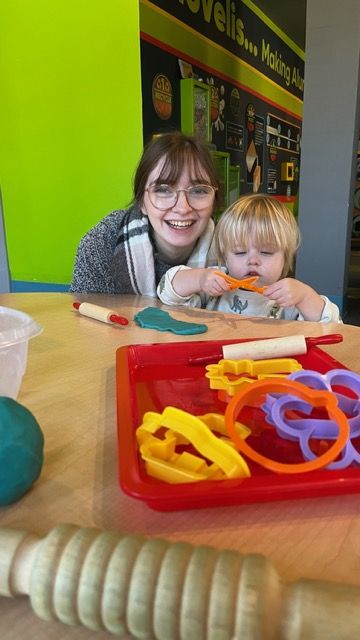
Have you ever watched a young child carefully peel a sticker from its backing, struggle to button a coat, or proudly show off a picture they've drawn?
These everyday moments may seem small, but something remarkable is happening. Children are learning how to coordinate their bodies, control their movements, and use their hands with increasing independence.
At the Children's Museum of Oswego, we believe some of the most meaningful learning happens through hands-on exploration. Whether children are building with blocks, creating art, manipulating materials, or experimenting with tools, they're developing skills that extend far beyond the activity itself.
One important part of that development is fine motor coordination.
And there's much more to it than simply strengthening little fingers.
What Are Fine Motor Skills?
Fine motor skills involve the small, controlled movements of the hands and fingers that allow us to complete everyday tasks.
Think about how many times you use your hands throughout the day. You button a shirt, turn a key, open a container, hold a fork, write a note, or pick up something small.
For adults, these movements often happen without much thought. For young children, they're skills that develop gradually through exploration, repetition, and experience.
According to the National Association for the Education of Young Children (NAEYC), everyday activities such as drawing, painting, cutting, building, and helping with meals offer valuable opportunities to develop hand strength and coordination.
But here's something parents may find surprising: successful fine motor movements depend on more than the hands themselves.
They also involve posture, shoulder stability, vision, coordination, sensory awareness, and the ability to plan movements.
Let's take a closer look.
Nine Important Foundations of Fine Motor Development
The following nine areas highlight important, interconnected abilities involved in fine motor development. They are not a standardized sequence or a checklist children must complete.
1. Postural Stability and Shoulder Control
It starts with a steady foundation.
Before children can make small, controlled movements with their hands, they benefit from being able to stabilize their bodies and shoulders.
Imagine trying to draw a picture while sitting on a chair that keeps wobbling. You would spend so much energy trying to stay balanced that controlling your pencil would become more difficult.
Children experience something similar.
A stable trunk and shoulders provide support for the arms, wrists, and hands.
What it looks like in everyday life: Sitting comfortably while drawing, reaching for materials, painting at an easel, or building a tall block tower.
How families can encourage it: Offer opportunities to play on the floor, build with large blocks, draw on different surfaces, and explore art in comfortable, supported positions.
2. Bilateral Coordination
Two hands working as a team.
Bilateral coordination is the ability to use both sides of the body together.
Sometimes both hands perform the same movement, such as rolling a piece of dough. Other times, each hand has a different job.
Think about cutting with scissors. One hand opens and closes the scissors while the other holds and turns the paper.
Or consider opening a container. One hand steadies it while the other twists the lid.
What it looks like in everyday life: Threading yarn, tearing paper, rolling dough, opening containers, and cutting with scissors.
How families can encourage it: Invite children to participate in cooking, create collages, manipulate construction materials, and explore art projects that naturally involve both hands.
3. Crossing the Midline
Reaching across the body.
Imagine an invisible line running down the center of your body, dividing it into left and right sides.
Crossing the midline means reaching across that line.
For example, a child might use their right hand to pick up a block on their left side or draw a large line across a piece of paper without switching hands.
This ability contributes to coordinated movement and efficient use of the hands.
What it looks like in everyday life: Reaching across a table, drawing large sweeping shapes, wiping a surface, or moving objects from one side of the body to the other.
How families can encourage it: Provide large drawing surfaces, invite children to paint broad strokes, and play games that involve reaching across the body.
4. Hand and Finger Strength
Learning to squeeze, press, and grasp.
Muscles in the hands and forearms work together to help children grip objects, manipulate materials, and use everyday tools.
But strength isn't simply about squeezing something as hard as possible. Children also learn how much effort different tasks require.
Think about the difference between squeezing a sponge and holding a delicate paintbrush.
What it looks like in everyday life: Manipulating clay, squeezing a spray bottle, using clothespins, fastening clothing, or pressing shapes into dough.
How families can encourage it: Offer soft clay, play dough, sponges, child-friendly kitchen tools, and other materials children can squeeze, pinch, pull, and manipulate.
5. In-Hand Manipulation and Finger Dexterity
Small movements that make a big difference.
Have you ever watched someone turn a coin around using only the fingers of one hand?
That ability is called in-hand manipulation.
It involves moving or adjusting an object within the hand without always needing help from the other hand.
Finger dexterity refers more broadly to the ability to make precise, coordinated finger movements.
What it looks like in everyday life: Adjusting the position of a crayon, turning a small object, manipulating buttons, or picking up and positioning game pieces.
How families can encourage it: Offer age-appropriate puzzles, building materials, art tools, and games that involve picking up, turning, and positioning objects.
6. Visual-Motor Integration
When the eyes and hands work together.
Visual-motor integration is the ability to coordinate hand movements with visual information.
When a child sees a shape and tries to copy it, they're using visual-motor skills.
The same is true when they guide a puzzle piece into place or aim a paintbrush toward a particular spot on the paper.
What it looks like in everyday life: Drawing shapes, completing puzzles, stacking blocks, tracing paths, and arranging materials into designs.
How families can encourage it: Explore puzzles, drawing, construction toys, simple mazes, and open-ended art activities that invite children to make intentional marks and arrangements.
7. Motor Planning and Sequencing
Thinking about how to make a movement happen.
Motor planning is the ability to figure out, organize, and carry out movements.
Imagine a child learning to cut along a curved line. They must determine how to position the scissors, move their fingers, turn the paper, and adjust their movements as they go.
That requires more than hand strength.
It requires planning.
What it looks like in everyday life: Learning to use scissors, building a structure, tying a knot, manipulating a new tool, or following a sequence of movements.
How families can encourage it: Provide opportunities to build, create, experiment, and solve problems. Allow children time to figure out how materials and tools work before stepping in to help.
8. Sensory Awareness and Pressure Control
Understanding how much force to use.
Our bodies constantly receive information about touch, movement, and position.
This sensory feedback helps us adjust our movements.
For example, children gradually learn the difference between pressing hard enough to make a crayon mark and pressing so hard that the paper tears.
They also learn how tightly to hold objects and how much pressure is needed to squeeze, pull, or release something.
What it looks like in everyday life: Painting with different brushes, squeezing glue, handling delicate materials, manipulating clay, and controlling crayon pressure.
How families can encourage it: Offer varied textures and materials, including clay, paper, fabric, water, paint, and sensory materials appropriate for the child's age.
9. Grasp Development and Hand Preference
Finding comfortable and effective ways to use tools.
Young children don't begin by holding crayons and pencils the way adults do.
Their grasp changes as their coordination and control develop.
A toddler may initially hold a crayon with their entire fist. With experience, children gradually develop more refined ways of holding and manipulating drawing and writing tools.
Children also develop a preference for using one hand for certain tasks. This can become more consistent over time.
It's important not to force a particular hand preference or assume every child must use exactly the same pencil grip.
What it looks like in everyday life: Scribbling with crayons, using paintbrushes, drawing shapes, manipulating utensils, and beginning to form letters.
How families can encourage it: Provide a variety of appropriately sized drawing and art tools. Let children experiment with different materials and offer opportunities for drawing and early writing without demanding perfect results.
Why These Foundations Matter Beyond Handwriting
Handwriting is one reason fine motor development deserves attention, but it's certainly not the only one.
These abilities also contribute to children's growing independence.
Think about the pride a child feels when they can finally zip their own jacket, pour a drink, use a fork, open their lunch container, or create something without needing an adult to do it for them.
Fine motor development supports participation in everyday life.
And while these foundational abilities contribute to writing readiness, children also need opportunities to practice drawing, making marks, forming letters, and eventually writing.
Art and hands-on play complement those experiences rather than replace them.
Why Art Is Such a Valuable Learning Experience
Art offers children something especially important: opportunities to explore movements while making their own decisions.
When a child presses clay into a shape, they're discovering how materials respond to pressure.
When they tear and arrange paper, they're coordinating their hands while experimenting with size, shape, and placement.
When they paint, they're learning to control a tool while expressing their ideas.
And when they draw, they're discovering that the movements of their hands can create meaningful marks.
At CMOO, we especially value process art, where children are encouraged to explore materials and create their own work rather than copy an adult's example.
The learning isn't measured by whether the finished artwork looks perfect.
It's found in the choices, discoveries, movements, and problem-solving that happen along the way.
Supporting Fine Motor Development at Home
The good news is that families don't need expensive educational materials or complicated activities.
Everyday experiences offer countless opportunities for children to use their hands.
Invite your child to help stir pancake batter, peel a banana, wash a table with a sponge, build with blocks, turn the pages of a book, draw a picture, or create something with recycled materials.
Offer a variety of experiences, follow their interests, and allow time for practice.
Most importantly, resist the temptation to complete every challenging task for them.
A little patience and encouragement can give children the opportunity to discover what they're capable of doing.
Children develop at different rates, and activities should be adapted to their abilities and interests. If you have concerns about your child's coordination, hand use, or ability to participate in everyday tasks, their pediatrician can help determine whether additional support would be beneficial.
Little Hands, Big Possibilities
The next time you watch your child carefully stack blocks, squeeze clay, thread materials, or proudly show you a drawing, consider everything happening beneath the surface.
Their hands are learning to work together. Their eyes and movements are becoming more coordinated. They're experimenting, solving problems, and gaining independence.
These experiences may look like simple play, but they're helping children develop abilities they'll use throughout their lives.
At the Children's Museum of Oswego, we believe that when children have opportunities to explore, create, and discover, even the smallest movements can lead to meaningful learning.
Continue Growing With Us
This article is the beginning of our Little Hands, Big Skills collection on Growing Curious Minds.
In future articles, we'll take a closer look at how these developmental foundations work and share creative, practical ways families can support them through everyday experiences.
Because growing curious minds begins with giving children opportunities to discover what they can do.
Sources & Further Reading
This article draws on established early-childhood education and pediatric occupational therapy guidance.
- National Association for the Education of Young Children (NAEYC): Help Your Child Build Fine Motor Skills
- NAEYC: What Will We Make? Using Process Art to Spark Preschoolers' Development
- American Academy of Pediatrics, HealthyChildren.org: Hand and Finger Skills of Your Preschooler
- Cambridgeshire and Peterborough NHS Foundation Trust: Occupational Therapy Toolkit
- Children and Family Health Devon: Play and Hand Skills – Bilateral Coordination
- Hampshire and Isle of Wight Healthcare NHS Foundation Trust: Handwriting and Fine Motor Skills
This article provides general educational information and is not intended to replace individualized developmental or medical guidance.
Written by the Children's Museum of Oswego as part of Growing Curious Minds, our educational blog exploring child development, hands-on learning, and the power of play.